AI in Online Real Estate Auctions: What Changes in 2026

- By BidHom Team
-
 Published on September 30, 2026
 7 minutes read
On this page
- Matrix: AI + online auctions are creating a smarter real estate ecosystem where data, buyer behavior, and competitive bidding increasingly work together.
- AI can transform how properties are discovered, valued, monitored, and matched with buyers, creating new possibilities for agents, brokers, sellers, and enterprises.
- From behavioral insights to anomaly detection, AI is bringing intelligence into auction workflows while leaving critical decisions and professional judgment in human hands.
- BidHom brings auctions, buyer management, analytics, property intelligence, bidding, and AI/ML capabilities into one connected digital ecosystem built for modern real estate professionals.
- As online property auctions evolve, the biggest opportunity may not be AI alone, but how intelligently it connects every stage of the auction journey.
AI is moving into one of real estate’s most time-sensitive spaces: online property auctions.
An online real estate auction already changes the traditional buying and selling process. Instead of waiting through rounds of negotiations, buyers compete within a defined bidding window, while sellers can create a structured environment for price discovery. Add AI to that process, and the platform can potentially do much more than simply host bids.
It can analyze buyer behavior, surface relevant properties, identify patterns in auction activity, support property valuation, automate routine communication, and help agents and brokers make sense of large amounts of data.
And this shift is already underway. NAR’s 2026 technology research found that 23% of REALTORS® use AI daily and another 25% use it weekly. Meanwhile, 81% said saving time is a primary reason they adopt technology, while 71% cited improving the client experience.
So, what does AI actually mean for online real estate auctions in 2026, and where does a platform like BidHom fit into the picture?
What Makes Online Real Estate Auctions Different?
Traditional real estate transactions often depend on listing prices, individual negotiations, and multiple rounds of offers.
An auction changes the dynamic.
The property is presented with defined auction rules, qualified buyers register, and competing bids help establish market demand within a specified period.
Online platforms take this a step further by allowing buyers to participate remotely. Depending on the auction, buyers may need to verify their identity, provide proof of funds, understand the auction terms, and complete due diligence before bidding.
That makes technology particularly important.
A modern real estate auction platform isn’t just a bidding screen. It can bring together:
- Property listings and search
- Buyer registration and management
- Real-time bidding
- Auto or maximum bidding
- Auction rules and offer management
- Property valuation tools
- Analytics and reporting
- MLS/IDX integrations
- Digital documents and transactions
- Payment integrations
- Automated communication

How AI Is Used in Online Real Estate Auctions
AI doesn’t need to replace the agent, broker or buyer to be useful.
Its biggest role may be handling the information-heavy work around the auction.
1. Smarter Property Discovery
AI can analyze a buyer’s stated preferences and previous interactions to surface properties that may be more relevant to them.
Instead of repeatedly filtering listings, a buyer could receive recommendations based on factors such as property type, location, price range, investment objective and previous activity.
For agents, this can also mean better visibility into which prospects are showing genuine interest.
2. Data-Driven Property Valuation
Pricing is one of the most important parts of an auction.
AI-powered valuation tools can process property and market data to generate estimates or insights that support pricing decisions. These tools can consider historical information, comparable properties and other available data.
That does not make an AI estimate an appraisal or guarantee a property’s eventual auction price. Human review and appropriate professional valuation remain important.
3. Understanding Buyer Behavior
One of the more interesting applications is behavioral analysis.
Machine-learning systems can examine patterns such as:
- Which properties buyers view
- How frequently they return
- When they engage
- Which property categories attract them
- How they interact with listings
- Their bidding activity
Over time, these patterns can help platforms personalize property discovery and communication.
This is where AI shifts from “automation” to “intelligence.”
4. Faster Auction Monitoring
Online auctions can generate large amounts of activity in a short period.
AI can help platforms monitor bidding activity, identify unusual patterns, and provide alerts when specific events occur.
The goal isn’t simply to make bidding faster. It is to help people avoid manually watching every development.
5. Better Fraud and Risk Monitoring
AI can also support anomaly detection.
Unusual account activity, suspicious bidding patterns, or inconsistencies in transaction behavior can potentially be flagged for human review.
However, AI should support, not replace, established identity verification, compliance procedures, and human oversight.
The Numbers Show Why AI Matters to Real Estate Professionals
AI adoption among real estate professionals is moving into everyday workflows.

NAR’s 2026 report also found that 63% of agents identified the learning curve as their biggest technology-adoption challenge, showing that simply adding AI isn’t enough. The technology has to be practical and easy to use.
That matters enormously for auction platforms.
The most useful AI isn’t necessarily the most complicated AI. It’s the AI that helps a broker manage more listings, helps an agent respond faster or helps a buyer find relevant opportunities without adding another layer of complexity.
AI-Powered Real Estate Auction Software: Where BidHom Fits
This is where BidHom brings the different pieces together.
BidHom is built around the idea that real estate professionals should be able to manage listings, auctions, buyers, offers, and transactions through a connected digital platform.
Its current capabilities include auction management, auto maximum bidding, reverse auctions, multiparcel auctions, highest-and-best offers, buyer management, reports and analytics, property value estimation, asset alerts, transaction management and MLS/IDX integration.
Its Enterprise offering also includes AI/ML learning for buying behavior, CRM and third-party integrations, white-label solutions, and complete code access.
For agents and brokers, that creates a practical foundation for using AI without treating it as a separate experiment.
For agents
BidHom can help agents bring listings online, manage auctions, track buyer activity, and create a more streamlined digital experience.
For brokers
Multi-agent functionality, listing management, analytics and auction tools can help brokers manage their teams and inventory from one environment.
For buyers
Online bidding, property discovery, alerts and digital auction workflows can make it easier to find and participate in opportunities remotely.
For sellers
A structured digital auction can expand buyer access, create competitive bidding, and provide greater visibility into offers and auction activity.
For enterprises
White-label capabilities, AI/ML functionality, integrations, and transaction infrastructure allow businesses to build a more customized auction marketplace around their own brand and workflow.
What Could AI Bring to Real Estate Auctions Next?
The next stage may be less about AI simply doing tasks and more about AI connecting decisions.
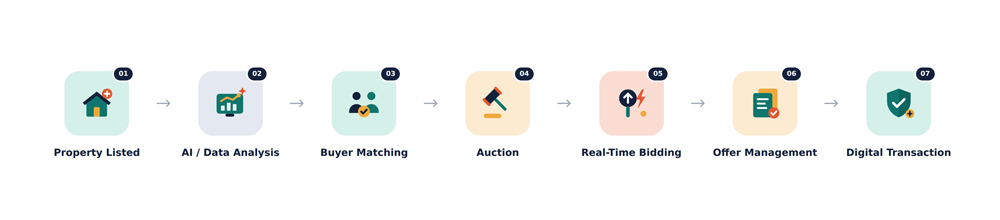
Imagine an auction platform that can identify a buyer’s preferences, surface suitable properties, provide relevant valuation insights, alert them to important auction activity, and help an agent prioritize the prospects most likely to engage.
That is a very different experience from simply putting a “Bid Now” button on a listing.
BidHom’s BidNow product already illustrates this direction by allowing businesses to add live property bidding to an existing website without redesigning the site. It supports real-time bid updates and is designed to keep buyers within the existing website experience.
But AI Doesn’t Remove the Need for Human Judgment
This is an important part of the 2026 conversation.
NAR’s research shows that agents see value in AI, but accuracy remains a concern. In a February 2026 RPR survey, 63% of surveyed agents identified accuracy of AI outputs as their top concern.
Real estate also brings additional responsibilities around fair housing, privacy, MLS data, advertising, and professional judgment.
HUD has specifically addressed the risks of using automated systems and AI in housing advertising, while NAR has highlighted concerns involving fair housing, data provenance, and MLS compliance.
So the practical model for 2026 isn’t: AI replaces the real estate professional.
It is: AI handles more of the data-heavy work. People remain responsible for judgment, advice, and decisions.
The Real Opportunity for Real Estate Professionals
Online real estate auctions are already changing how properties can be marketed and sold. AI adds another layer by making these platforms more responsive, data-driven, and personalized.
For agents and brokers, the opportunity isn’t simply to “use AI.”
It is to use AI inside a workflow that already handles listings, auctions, buyers, offers, and transactions.
That is the direction BidHom is building toward, combining an online real estate auction platform with AI/ML capabilities, property intelligence, automation, and transaction tools.
As the real estate industry becomes increasingly digital in 2026, the question may no longer be whether AI belongs in property auctions.
The bigger question is how intelligently the auction experience can use it.



Share Article