Real Estate Agent vs. REALTOR®: 7 Differences Every Home Buyer Should Know

- By BidHom Team
-
 Published on August 4, 2026
 9 minutes read
On this page
- Every REALTOR® is a licensed agent — not every agent is a REALTOR®.
- REALTOR® = NAR membership. Broker = license level. Separate things.
- REALTORS® follow an added Code of Ethics, plus ongoing training.
- Since Aug 17, 2024, buyers sign a written agreement before touring homes.
- Commissions haven't dropped — they're just negotiated up front now.
Buying or selling a property is one of the biggest financial decisions most people make, yet many still confuse a real estate agent, a REALTOR®, and a real estate broker. All three help clients buy and sell property, but their qualifications, responsibilities, and level of authority differ. Understanding these distinctions helps you choose the right professional, avoid costly mistakes, and make more confident real estate decisions.
The industry is also evolving fast. Buyers expect quicker access to information, greater transparency, and a smoother buying experience, and the rules of the transaction itself changed in a major way in 2024 (more on that below). As real estate becomes increasingly digital, professionals are adopting smarter tools to serve clients more efficiently.
The U.S. Real Estate Market in Numbers (2026)
Home buying has become more digital, buyers are better informed than ever, and real estate professionals are adapting to changing expectations.
2026 U.S. Real Estate Snapshot
- 97% — Share of homebuyers who use the internet during their home search (NAR).
- ~1.44 million — Active members of the National Association of REALTORS® as of mid-2026, down from a 2022 peak near 1.5 million (NAR).
- ~5.7% — Average total real estate commission in 2026, below the traditional 6% (Clever, 2026).
- ~4 million — Annual existing-home sales pace, the lowest since 1995, keeping the market competitive for buyers.
Who Makes a Real Estate Transaction Possible?
A successful property transaction involves more than a buyer and a seller. Several professionals work together behind the scenes to keep the process legal, transparent, and efficient.
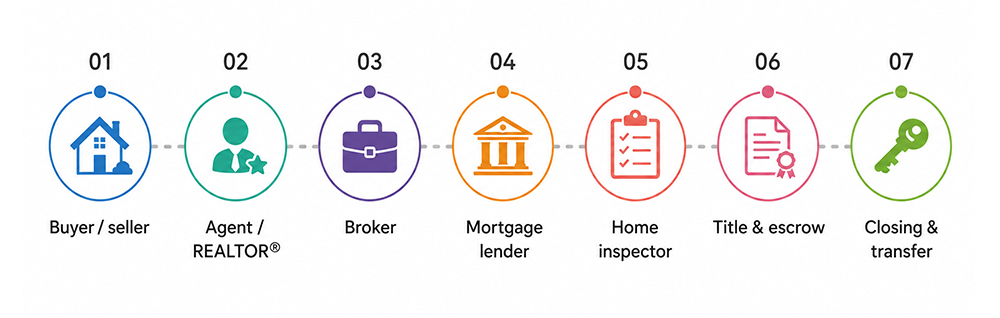
Although every professional plays an important role, the real estate agent or REALTOR® is typically the client’s primary point of contact, guiding them from the initial property search to the final closing.
What Is a Real Estate Agent?
A real estate agent is a state-licensed professional who helps clients buy, sell, rent, or lease residential and commercial properties. To become licensed in the United States, candidates must complete state-approved education, pass a licensing examination, and comply with their state’s real estate laws.
Today’s agents do far more than show homes. They act as trusted advisors, helping clients read market trends, set competitive pricing, negotiate offers, prepare contracts, coordinate inspections, and navigate closing. Their expertise helps buyers avoid costly mistakes and helps sellers market their properties more effectively.
Key responsibilities of a real estate agent
- Listing and marketing properties
- Conducting property showings
- Preparing Comparative Market Analyses (CMAs)
- Negotiating offers and counteroffers
- Coordinating inspections and appraisals
- Managing contracts and legal documentation
- Guiding clients through closing
Modern agents also rely on CRM platforms, virtual tours, AI-powered marketing, digital listing tools, and a professional real estate agent website to reach more buyers, generate leads, strengthen their online presence, and simplify transactions.
What Is a REALTOR®?
A REALTOR® refers to a qualified real estate expert who has joined the National Association of REALTORS® (NAR) organization. Unlike the word “real estate agent,” which is a broad term, REALTOR® is a trademark and can only be used by the organization’s members.
In order to become a REALTOR®, the agent must possess a real estate license, join a local real estate association, and adhere to the organization’s code of ethics (works honesty, fairness, openness, confidentiality, and liability).Members also complete ongoing ethics training to keep the designation.
Every REALTOR® is a licensed real estate professional, but not every licensed agent is a REALTOR®. For consumers, the designation signals a commitment to an added layer of professional standards on top of state licensing. Many REALTORS® also invest in IDX websites for realtors to showcase live MLS listings and reinforce that same professional credibility online.
Where Does a Real Estate Broker Fit In?
A licensed real estate broker has gone through a series of education and licensing requirements over and above the basic obligations as an agent. Brokers possess an extensive knowledge of real estate law, agreements, and transactions and supervise agents, run real estate brokerages, and work for themselves.
Unlike agents, brokers can work with clients directly and can represent them in complex transactions. Brokers can also choose to join NAR and become a REALTOR® Broker, and then adhere to the Code of Ethics that applies to all the members of the REALTOR® community.
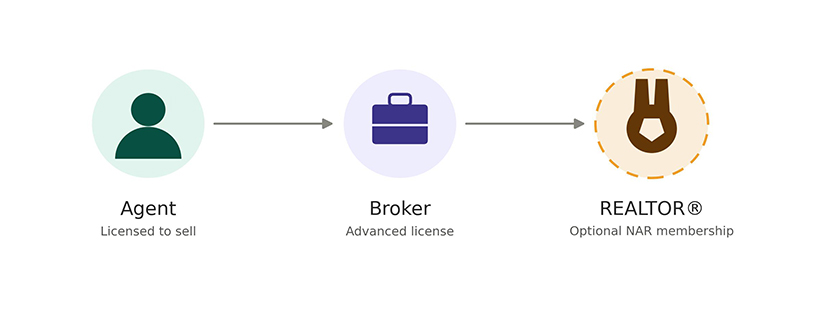
Note that “REALTOR®” and “broker” describe two different things: NAR membership versus license level. A person can be one, both, or neither.
The 7 Key Differences Between a Real Estate Agent and a REALTOR®
Both are state-licensed and both can help you buy or sell. The differences come from NAR membership. Here are the seven that matter most:
- Professional membership. A REALTOR® is an active member of the National Association of REALTORS®. A real estate agent may or may not be a member; if they aren’t, they simply aren’t a REALTOR®.
- Code of ethics. A REALTOR® agrees to follow NAR’s Code of Ethics, which goes beyond the minimum standards set by state law. A non-member agent is bound only by state licensing rules.
- Use of the REALTOR® trademark. Only NAR members may call themselves a REALTOR® or use the trademark and logo. Misusing it without membership isn’t allowed.
- Ongoing ethics training. NAR requires members to complete Code of Ethics training on a recurring cycle to stay in good standing. There’s no equivalent NAR requirement for a non-member agent.
- Accountability and dispute resolution. REALTORS® can be held accountable through NAR and local board enforcement and arbitration, in addition to state licensing boards, providing an extra layer of oversight for consumers.
- Access to NAR tools and data. Membership provides access to REALTOR®-specific resources, market data, and technology tools, along with the association’s advocacy work.
- Cost of membership. REALTORS® pay national, state, and local association dues on top of their licensing costs, a difference that sits behind the added standards and resources.
Quick take: Every REALTOR® is a licensed real estate professional, but not every licensed real estate professional is a REALTOR®.
Agent vs. REALTOR® vs. Broker at a glance
| Feature | Real Estate Agent | REALTOR® | Broker |
| Holds a state real estate license | Yes | Yes | Yes (advanced broker license) |
| Member of NAR | No | Yes | Optional |
| Bound by NAR Code of Ethics | No | Yes | Only if a NAR member |
| May use the REALTOR® trademark | No | Yes | Only if a NAR member |
| Can supervise agents / own a brokerage | No | Only if licensed as a broker | Yes |
| Can work independently | Depends on state rules | Depends on license level | Yes |
“REALTOR®” reflects NAR membership; “broker” reflects license level. They’re separate, which is why a broker can also be a REALTOR®.
The 2024 NAR Settlement: What Changed for Buyers and Sellers
This is the most important recent shift in the industry, and any buyer or seller in 2026 should understand it. Following antitrust litigation and a $418 million settlement, new business practices took effect on August 17, 2024 that changed how buyer-agent commissions are handled.
What actually changed:
- Written buyer agreements come first. Buyers working with an MLS-participant agent generally must sign a written buyer-broker agreement before touring homes. It spells out the agent’s fee, what services are included, and who is expected to pay.
- Compensation is off the MLS. Offers of buyer-agent compensation can no longer be advertised on the Multiple Listing Service. Any such offer is now negotiated directly between the parties, outside the MLS or written into the purchase contract.
- Everything is negotiable. Commission rates are not set by law and never have been. Sellers may still choose to offer buyer-agent compensation or concessions, but buyers can no longer assume it. In competitive markets, some listings are structured as a highest and best offer process to keep multiple-offer negotiations transparent.
What this means in practice: Despite predictions of sharp drops, average buyer-agent commissions have stayed close to pre-settlement levels, typically around 2–3% of the purchase price, with total commissions averaging roughly 5.7% in 2026. The biggest change is transparency: the number is now discussed and documented up front rather than assumed at closing.
Buyer tip: Read and understand your buyer-broker agreement before you start touring. Ask what the fee covers and how it will be paid, in the offer, by the seller, or by you.
Myth vs. Fact
| Myth | Reality |
| Every real estate agent is a REALTOR®. | No — REALTORS® must be active NAR members. |
| REALTORS® hold a different license. | No — they hold the same state license, plus NAR membership. |
| Brokers and agents do the same job. | No — brokers hold a higher-level license and can supervise agents and run a brokerage. |
| The seller always pays the buyer’s agent. | Not anymore — since August 2024, buyer-agent compensation is negotiated deal by deal. |
| You only need an agent to buy or sell. | Professionals also help with pricing, negotiation, paperwork, compliance, and market insight. |
Which Professional Should You Choose?
The right choice depends on your goals.
- Buying your first home: Choose an experienced agent or REALTOR® who knows the local market, negotiates well, and can walk you through the new buyer-agreement process step by step.
- Selling a property: A skilled REALTOR® or broker can market your home, attract qualified buyers, and help you think through your compensation strategy under the current rules. Some sellers are also turning to a real estate auction to create urgency and speed up the sale.
- Investing or developing: An experienced broker can open the door to commercial opportunities, off-market listings, and strategic advice.
- Want added ethical assurance: Choose a REALTOR®, who commits to NAR’s Code of Ethics on top of state licensing.
Tip: Whatever the title, experience, communication, and local market expertise usually matter more to your outcome than the label alone.
The Future of Real Estate in 2026: Technology as a Competitive Advantage
The U.S. real estate market is no longer driven by location and pricing alone; it’s increasingly shaped by technology. Buyers want instant access to verified property information. Sellers expect wider visibility, and professionals want smarter ways to close deals. Formats like the Dutch auction are one example of that shift, using a declining-price structure to move stagnant listings faster. In 2026, digital tools aren’t just an advantage; they’re becoming essential to staying competitive.
| Trend | Impact on the industry |
| AI-powered property recommendations | Faster, more personalized property discovery |
| Virtual tours | Better decisions before physical visits |
| Online documentation & e-signatures | Quicker, paperless transactions |
| Mobile-first property search | Greater convenience for buyers and sellers |
| Verified listings | More transparency and trust |
How Bidhom Supports Modern Real Estate
As real estate goes digital, professionals need platforms that simplify the whole property journey, not just display listings. Bidhom brings buyers, sellers, agents, brokers, and developers together in one place, with verified listings, transparent online auctions and real-time bidding, centralized listing management, and wider reach to genuine buyers.
Final Thoughts
Understanding the differences between a real estate agent, a REALTOR®, and a broker helps you choose the right professional for your needs, and understanding the 2024 rule changes helps you navigate today’s transactions with confidence. Experience, local knowledge, and communication still matter most, but technology is redefining how properties are discovered, marketed, and sold. Combining trusted expertise with modern digital tools leads to faster, more transparent, and more efficient transactions for everyone involved.



Share Article