7 Types of Real Estate Auctions: How Smart Investors Win Big in 2026

- By BidHom Team
-
 Published on February 24, 2026
 8 minutes read
On this page
- Real estate auctions are no longer limited to distressed assets — they are becoming a strategic selling tool for brokers, enterprises, and serious investors in 2026.
- Choosing the right auction type can directly impact pricing power, speed of sale, risk exposure, and overall transaction certainty in competitive markets.
- Auctions create structured urgency that traditional listings often fail to generate, helping sellers control timelines while attracting highly qualified buyers.
- Digital transformation is reshaping auction participation, expanding reach, increasing transparency, and unlocking new opportunities for national and institutional investors.
- Success in auctions depends on preparation, strategy, and positioning — professionals who understand the mechanics gain a measurable advantage over reactive competitors.
Thousands of properties, including foreclosures, bank-owned houses, and private listings, were sold at auction in the United States in 2023. The National Association of REALTORS® (NAR) asserts that auctions are still a methodical and open approach to effectively selling real estate, especially where competitive pricing and time certainty are top concerns.
Auctions are no longer restricted to distressed properties due to tighter inventory, rising interest rate cycles, and motivated sellers. In order to speed up transactions and lower holding costs, more brokers and businesses are implementing auction tactics in 2026.
Consequently, we shall simplify everything in this extensive guide.
Understanding Real Estate Auction
A real estate auction is a public sale where property is sold to the highest bidder under predefined terms and conditions. Instead of negotiating back and forth for weeks, auctions create urgency, competition, and time-bound transactions.
Unlike traditional listings, auctions:
- Have a fixed bidding window
- Require qualified buyers
- Often involves non-refundable deposits
- Set clear terms before bidding begins
Note: For agents and brokers, auctions reduce uncertainty. For sellers, they create competitive price discovery. For buyers, they offer transparency.
How Does a Real Estate Auction Work?
Below, we have explained how a real estate auction works in a simple flow;
1. Property Preparation: The property is marketed with disclosures, inspection details, and auction terms.
2. Marketing Campaign: Intensive short-term marketing drives serious buyers.
3. Buyer Qualification: Interested bidders register and submit deposits.
4. Auction Day: Bidders compete either live, sealed, or digitally.
5. Winning Bid & Contract: Highest qualified bid wins (based on auction type), followed by contract signing and closing timeline.
Now let’s talk about the different types.
Detailed Breakdown of All Types of Real Estate Auction
Understanding auction types is critical because the structure determines pricing strategy, risk exposure, buyer psychology, and sale certainty. Each format serves a different purpose, and choosing the wrong one can cost time and money.
Let’s break them down properly.
1. Absolute Auction (No-Reserve Auction)
An absolute auction means the property sells to the highest bidder, regardless of price. There is no minimum and no reserve.
How It Works
Once bidding begins, the seller has no control over the final sale price. The highest bid at the close of the auction wins, and the property must sell.
Why Sellers Choose It
This format creates maximum urgency. Buyers know the property will sell, which often drives aggressive bidding. It’s commonly used when:
- The seller needs a guaranteed sale
- The property must be liquidated quickly
- Estate settlements or distressed situations require certainty
Risks & Benefits
For sellers, the risk is price uncertainty. For buyers, the benefit is full transparency and confidence that the property won’t be withdrawn.
This type often generates high turnout because bidders trust the process.
2. Reserve Auction
A reserve auction allows the seller to set a confidential minimum price (the reserve). The property only sells if bidding meets or exceeds that amount.
How It Works
Bidding is public, but the reserve price is usually not disclosed. If the highest bid doesn’t meet the seller’s expectations, the seller can reject it.
Why It’s Popular
This is one of the most commonly used formats in U.S. real estate auctions because it balances seller protection with competitive bidding.
Best For
- High-value residential properties
- Commercial real estate
- Sellers who want flexibility
It protects against underselling while still leveraging competition.
3. Minimum Bid Auction
In a minimum bid auction, the seller publicly announces the lowest acceptable starting price.
How It Works
Bidding starts at the stated minimum amount and increases competitively.
Strategic Advantage
This method anchors buyer expectations while still creating bidding competition.
It works well when:
- The seller wants transparency
- The property has clear comparable sales
- Market demand is moderate to strong
Unlike reserve auctions, buyers know the minimum threshold upfront.
4. Sealed Bid Auction
A sealed bid auction is more private and structured.
How It Works
Interested buyers submit confidential written offers by a deadline. Bidders do not see competing offers.
After reviewing all submissions, the seller chooses the most favorable bid — which may not always be the highest if terms differ.
Common Use Cases
- Luxury homes
- Government property sales
- Institutional real estate portfolios
This method reduces emotional bidding and is often preferred for premium assets.
5. Foreclosure Auction
A foreclosure auction happens when a lender sells a property after the owner defaults on mortgage payments.
How It Works
The property is auctioned publicly, often at county courthouses or trustee sales. Bidding may start at the amount owed on the loan.
If no third-party buyer wins the bid, the property becomes bank-owned (REO).
Key Considerations
- Properties are often sold “as-is”
- Limited inspection opportunities
- Payment terms may require cash or short closing windows
This auction type attracts investors looking for discounted properties.
6. Tax Lien and Tax Deed Auction
Local governments conduct tax auctions when property owners fail to pay property taxes.
There are two structures:
Tax Lien Auction
Investors bid on the lien (not the property itself). The property owner must repay the debt with interest.
Tax Deed Auction
If taxes remain unpaid, the property itself is auctioned.
These auctions can offer high return potential but come with legal complexity. Due diligence is essential.
7. Real Estate Online Auction
A real estate online auction allows buyers to bid digitally within a set timeframe.
How It Works
Bidding takes place on a digital platform. Participants register, verify identity, and place bids during a scheduled window.
Advantages
- Broader geographic participation
- Data-driven bidding insights
- Greater transparency
- Flexible bidding timelines
This model expanded significantly after 2020 due to digital adoption and continues to grow as more buyers prefer remote participation.
Auction Types Comparison Table
A quick comparison table is provided below to clearly distinguish the differences.
| Auction Type | Seller Control | Buyer Risk | Sale Guarantee | Best For |
| Absolute | Low | Moderate | High | Urgent sales |
| Reserve | High | Moderate | Medium | Balanced strategy |
| Minimum Bid | Medium | Moderate | Medium | Price positioning |
| Sealed Bid | High | Low | Low | Premium properties |
| Foreclosure | Low | High | High | Investors |
| Tax Auction | Low | High | High | Speculative buyers |
| Real Estate Online Auction | Medium | Moderate | Medium | Wider Exposure |
Choosing the Right Auction Type: Strategic Decision Framework
Before selecting a structure, ask these 5 important questions:
- Is speed more important than price?
- Does the property have strong demand?
- Is seller flexibility required?
- Are buyers local or national?
- Is the asset distressed, premium, or commercial?
Professional realtors and brokers must match auction type with property positioning. A mismatch can reduce bidding activity.
Why Auctions Are Gaining Popularity in 2026
According to NAR’s Consumer Guide to Real Estate Auctions, auctions:
- Create transparent competitive bidding
- Shorten selling timelines
- Attract serious buyers
- Reduce negotiation delays
Market Shift Indicators for 2026
- Increased investor activity in distressed properties
- Sellers seeking faster liquidity
- Growing digital adoption in property transactions
- Broker demand for alternative selling models
Auctions help control time, not just price — and in 2026, time equals money.
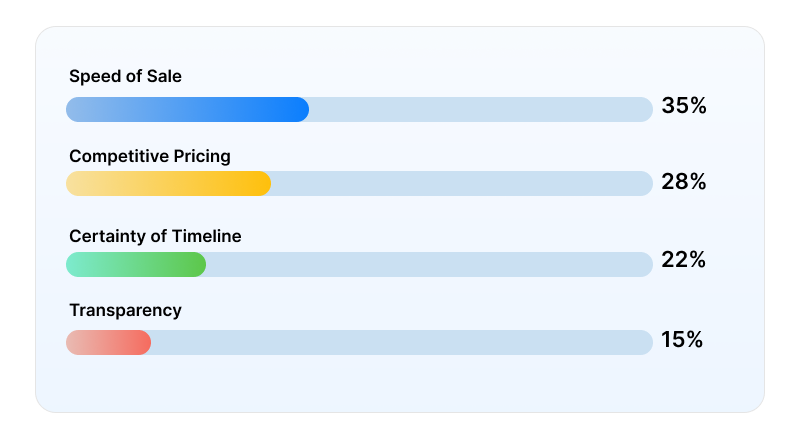
Why Sellers Choose Auctions
Reason for Choosing Auction (Survey Insights)
Expert Tips to Maximize Auction Success
For Sellers
- Choose the right auction type based on urgency.
- Invest heavily in short-term marketing.
- Set realistic reserve pricing.
- Provide complete disclosure to increase bidder trust.
For Buyers
- Inspect the property beforehand.
- Understand auction terms carefully.
- Arrange financing in advance.
- Avoid emotional bidding.
For Agents & Brokers
- Use auctions for difficult listings.
- Pre-qualify bidders to ensure serious participation.
- Structure marketing campaigns around scarcity and deadlines.
- Position auctions as strategic, not distressed sales.
Powerful Tools That Improve Auction Results
- Data-driven pricing analysis
- CRM-integrated bidder tracking
- Automated bidding systems
- Secure digital documentation
- Marketing analytics dashboards
Modern auction platforms allow brokers to track bidder behavior and optimize campaigns in real time.
Common Mistakes to Avoid
- Overpricing reserve
- Weak marketing window
- Ignoring buyer qualification
- Not understanding state-level auction laws
- Emotional bidding behavior
Preparation separates professionals from amateurs.
Purpose of a Real Estate Auction
Auctions exist to:
- Discover true market value
- Accelerate transactions
- Increase competition
- Reduce long negotiation cycles
- Provide transparent sales processes
For enterprises and institutional sellers, auctions offer portfolio liquidation efficiency. For investors, they offer opportunity access.
The Outlook of 2026: What’s Next?
Industry trends indicate:
- Increased digital participation
- Broader institutional adoption
- More hybrid auction models
- Integration with real estate fintech ecosystems
The second wave of real estate online auction platforms is likely to focus on transparency, data insights, and enterprise integration. Auctions are evolving from distressed-only channels to strategic selling tools.
Final Thoughts
Ignoring auctions in 2026 will cost you speed, competition, and market-driven pricing power if you are a realtor, broker, investor, or property company in the United States.
The most astute professionals adjust to the market rather than waiting for it. By developing organised, easily accessible methods for both buyers and sellers at a reasonable cost, platforms such as Bidhom are contributing to the modernisation of auction participation.
To gain a deeper understanding of auction strategy and investigate potential for structured bidding.



Share Article